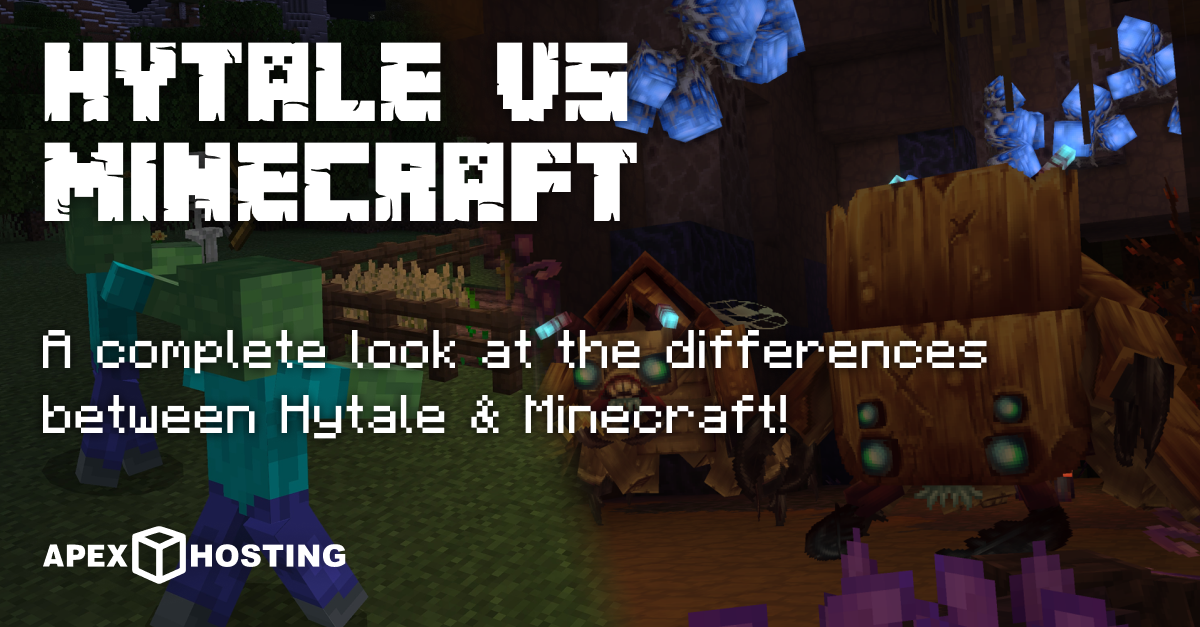
Fans of Minecraft have been watching Hytale closely ever since its announcement, curious about how this sandbox title expands on familiar ideas. While both games share many similarities, each approaches these concepts completely differently. From building worlds to survival progression, Hytale and Minecraft are two different beasts.
In this article, we will compare both of these games to find out their similarities and differences. We’ll discover what makes them unique and showcase each one in all their glory. Whether we’re talking about modding or exploration, Hytale vs Minecraft is truly an interesting comparison.
⚠️ Hytale is in Early Access, more content and features will be added in the future.
Core Similarities & Differences
Hytale and Minecraft begin with the same familiar framework: a procedurally generated world built from blocks you can gather, break, or rebuild. You collect resources, craft tools, create shelters, and push deeper into unexplored regions as you become stronger. Beyond that shared foundation, each game moves in a different direction.
Hytale adds structure to the sandbox formula. Its world is divided into themed Zones, each introducing distinct biomes, enemies, challenges, and difficulty levels. This creates a loose but meaningful sense of progression that ties into story moments and curated encounters.
Minecraft keeps the world almost entirely open. Players receive no direction and set their own goals, whether they prefer building, exploring, farming, automation, or large engineering projects. This open canvas approach is central to the game’s identity.
Before going deeper, here is Hytale vs Minecraft – a complete comparison:
| Hytale (Early Access) | Minecraft (Java Edition) | |
|---|---|---|
| Core Design | Sandbox adventure with light RPG structure | Fully open sandbox with minimal guidance |
| World Layout | Distinct Zones with rising difficulty | One open world with no intended order |
| Exploration Style | Exploration supported by curated encounters | Exploration for discovery and curiosity |
| Progression | Tiered materials, stations, and equipment linked to Zones | Flexible progression driven by player choice |
| Combat | More detailed combat with varied enemy behaviors | Simple combat, expanded heavily by mods |
| Building and Creativity | Block-style freedom with built-in prefab and creation tools | Unlimited freedom shaped by player imagination |
| Modding System | Official tools, asset editor, visual scripting, and automatic downloads | Community mod loaders like Forge and Fabric; manual installation required |
| Joining Modded Servers | Players join and receive required content automatically | Players must install matching client mods |
| Technical Focus | Accessible tools for designing custom game modes | Deep automation through Redstone mechanics |
| Overall Philosophy | A guided adventure supported by strong creation tools | A wide-open canvas for any playstyle |
Reminder: Hytale is currently in Early Access, so features can be extremely limited or not implemented yet. E.g. curated experiences, story content, etc..
Exploration & Structure
Hytale adds intention to exploration. Its Zones offer unique environments, enemies, and handcrafted structures designed to guide players forward. Prefabs and curated encounters are integrated into generation, creating a sense of progression without removing freedom.
Minecraft treats exploration as an open journey. The world is filled with biomes, caves, and structures that appear naturally, with little implied direction. Players explore because they want to, not because the world encourages them along a path. It rewards improvisation and experimentation.
Progression & Gameplay Style
Hytale follows a structured progression path tied to each Zone. As players advance, they encounter stronger enemies, discover new materials, and upgrade tools and gear through tiered crafting stations. The loop resembles a light RPG experience, encouraging players to prepare before tackling tougher regions.
Minecraft’s progression is flexible and defined by you. The game presents broad goals such as defeating the Ender Dragon or Wither, but none of them are required to enjoy the experience. Building, automation, farming, or exploration can replace traditional progression entirely.
Creation & Modding
Hytale aims to streamline creation from the start. The game includes official tools such as an asset editor and a visual scripting system that allow creators to build custom content, logic systems, and full game modes without external loaders. Because mods are stored on the server and downloaded automatically, players join seamlessly with no setup.
Minecraft’s modding scene is enormous and community-driven. Tools like Forge and Fabric enable nearly unlimited content, but players must install every mod manually and ensure versions match. This creates impressive possibilities with a more involved setup. Minecraft excels in long-term mod variety, while Hytale focuses on accessibility and integrated tools.
The Bigger Picture
Hytale and Minecraft share a creative sandbox foundation, yet each interprets that foundation through its own design goals and player experiences. Minecraft has spent years refining its open-ended style, while Hytale aims to offer a more guided structure supported by built-in tools and systems. Looking at them side by side helps clarify how the genre has evolved and how different approaches can grow from the same core ideas. As development continues, both games contribute to the broader landscape of sandbox creativity in distinct and meaningful ways.